Abstract
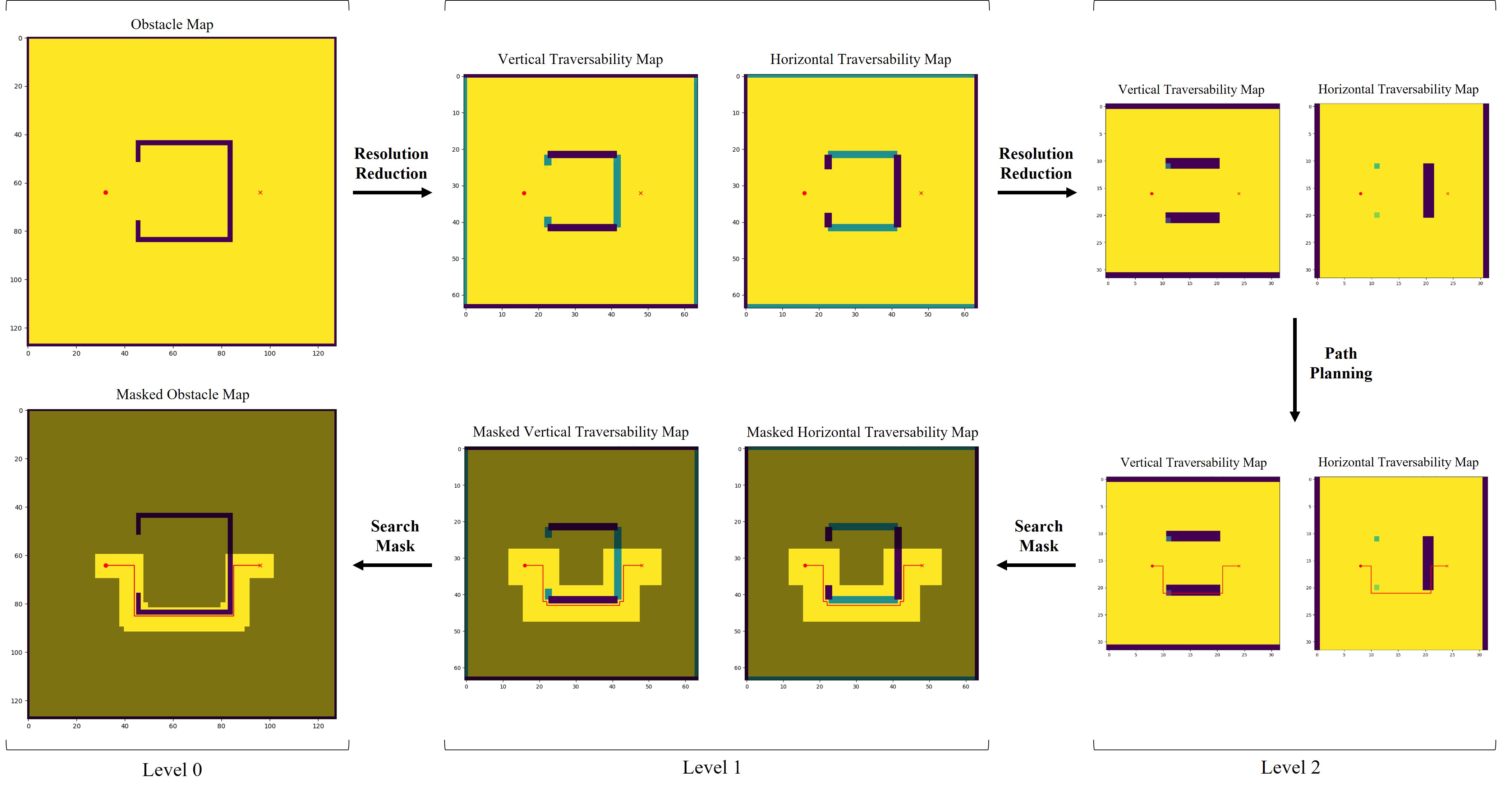
Path planning on grid-based obstacle maps is an essential and much-studied problem with applications in robotics and autonomy. Traditionally, in the AI community, heuristic search methods (e.g., based on Dijkstra, A∗, or random trees) are used to solve this problem. This search, however, incurs a high computational cost that grows with the size and resolution of the obstacle grid and has to be mitigated with effective heuristics to allow path planning in real-time. This work introduces a learning framework using a deep neural network with a stackable convolution kernel to establish a hierarchy of directional traversability representations with decreasing resolution that can serve as an efficient heuristic to guide a multi-resolution path planner. This path planner finds paths efficiently, starting on the lowest resolution traversability representation and then refining the path incrementally through the hierarchy until it addresses the original obstacle constraints. We demonstrate the benefits and applicability of this approach on datasets of maps created to represent both indoor and outdoor environments to represent different real-world applications. The conducted experiments show that our method can accelerate path planning by 40% in indoor environments and 65% in outdoor environments compared to the same heuristic search method applied to the original obstacle map, which demonstrates the effectiveness of this method.
2022 IEEE International Conference on Systems, Man, and Cybernetics (SMC)